ENG

INTRODUCTION

The People’s Adaptation Plan for Mongla Port Municipality is a community-driven blueprint for building a climate resilient, and migrant friendly coastal town. Piloted by the Global Center on Adaptation and BRAC with technical support from ICCCAD and SPARC and funding from the UK Government– the process brings together Mongla’s citizens and local government to turn local knowledge into practical climate solutions. By putting the most vulnerable in the driving seat of planning for urban resilience and climate planning, this People’s Adaptation Plan seeks to ensure that their needs are prioritized by climate investments, and that scare resources are used efficiently to address their vulnerabilities.

The People’s Adaptation Plan for Mongla Port Municipality is a community-driven blueprint for building a climate resilient, and migrant friendly coastal town. Piloted by the Global Center on Adaptation and BRAC with technical support from ICCCAD and SPARC and funding from the UK Government– the process brings together Mongla’s citizens and local government to turn local knowledge into practical climate solutions. By putting the most vulnerable in the driving seat of planning for urban resilience and climate planning, this People’s Adaptation Plan seeks to ensure that their needs are prioritized by climate investments, and that scare resources are used efficiently to address their vulnerabilities.

CLIMATE CHANGE IMPACTS ON MONGLA

Mongla faces worsening climate impacts from more frequent cyclones and floods, alongside slow-onset risks such as sea-level rise, salinity intrusion, river erosion, irregular rainfall, and rising temperatures. These changes are reducing freshwater availability, damaging agriculture and infrastructure, disrupting livelihoods, and increasing health risks, while accelerating displacement of poor and marginalized communities. Salinity and shrimp farming are degrading land and ecosystems and deepening inequality, and rising heat and erratic rainfall are intensifying water scarcity, food insecurity, and overall vulnerability.

METHODOLOGY

By putting Mongla’s most vulnerable citizens in the driving seat of planning for urban resilience and climate planning, this People’s Adaptation Plan seeks to ensure that their needs are prioritized by climate investments, and that scare resources are used efficiently to address their vulnerabilities. It draws on methodologies developed over decades by Slum Dwellers International and BRAC, to support the co-production of responses to climate change by vulnerable citizens in genuine partnership with their governments. The process delivered more than a set of documents. It strengthened community leadership and understanding of climate risks, built trust between residents and municipalities, and created a data-driven framework and baseline to guide future climate adaptation investments.

PEOPLE'S ADAPTATION PLANS FOR INFORMAL SETTLEMENTS

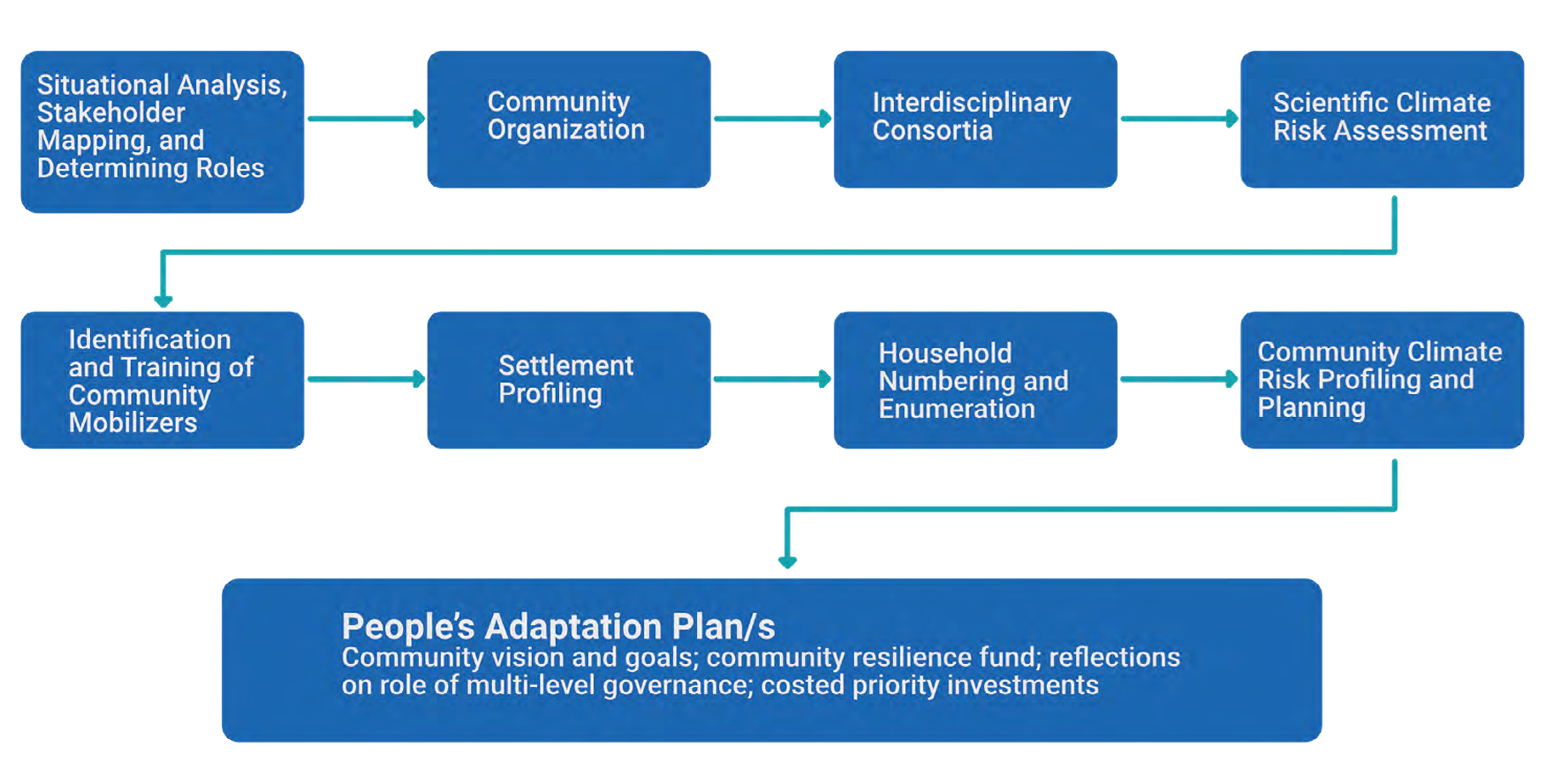
The plans for the 20 informal settlements were developed through a community-led People’s Adaptation Planning process. Trained local mobilizers first conducted a profiling exercise to identify the most climate-vulnerable settlements, followed by door-to-door household surveys to capture detailed socio-economic and climate risk data. This information was analysed and shared back with residents, who then jointly identified key hazards, ranked risks, and proposed locally viable solutions during participatory visioning sessions. These priorities were consolidated into costed People’s Adaptation Plans, which were subsequently reviewed and validated by communities.

people's-adaptation-plan---charabari.pdf
people's-adaptation-plan---diganta-colony.pdf
people's-adaptation-plan---narikel-tola.pdf