

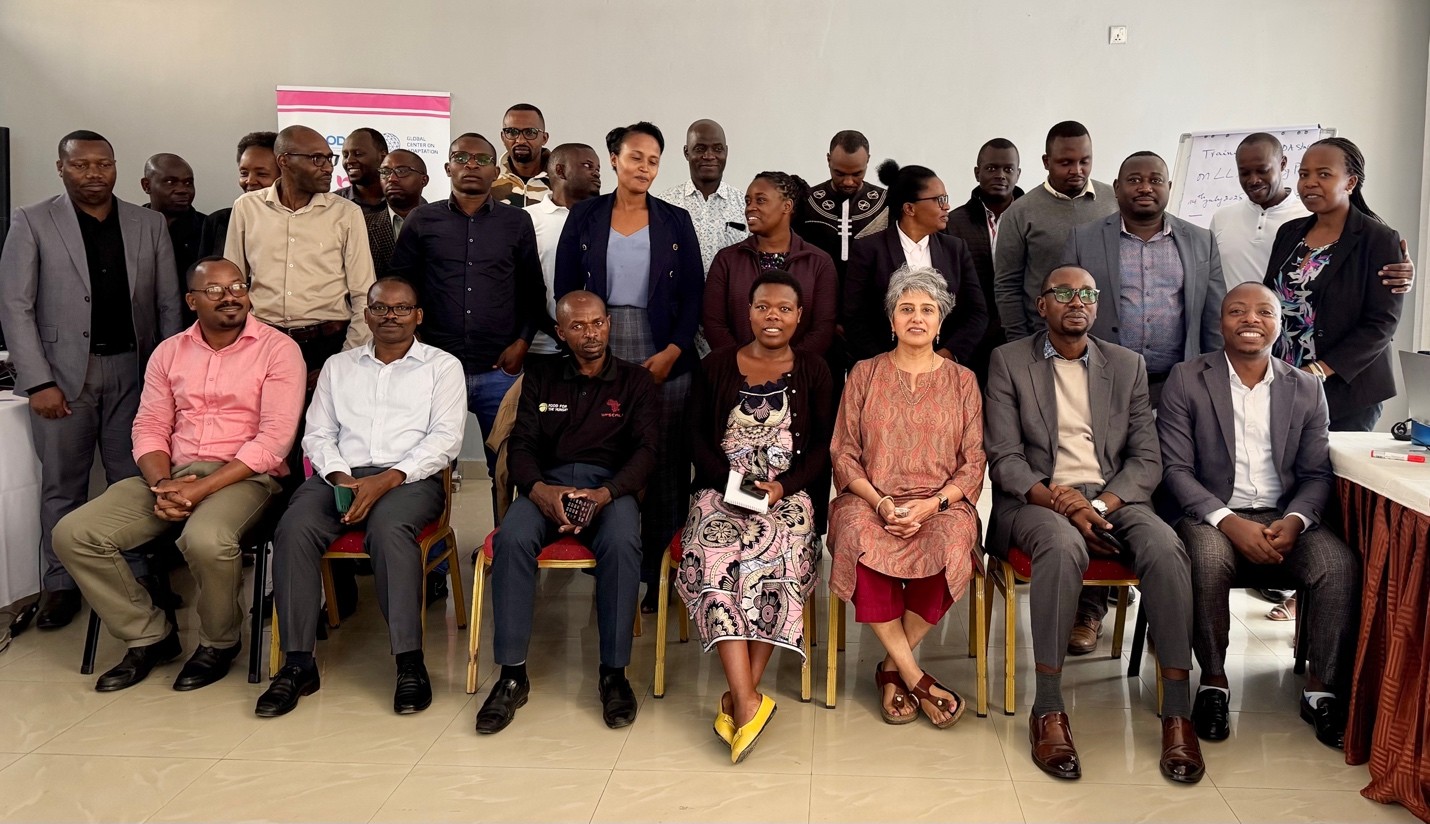
Musanze, Rwanda, 17July 2025 — Representatives of key national and local agencies in Rwanda were trained in facilitating locally led People’s Adaptation Plans during a four-day workshop in Musanze, Rwanda. The training shared lessons from piloting the integration of locally led adaptation (LLA) planning into Rwanda’s existing institutional and legislative framework in two pilot districts, Nyabihu and Ngororero, in the Western Province of Rwanda.
The piloting of People’s Adaptation Plans in the two districts and the training was facilitated by the Global Center on Adaptation’s local partner, BRAC Rwanda. It builds on a number of activities carried out earlier including awareness raising and sensitization, climate risks and vulnerability assessments and co-creation of climate response actions. Once validated, the community developed plans will be submitted to the Local Administrative Entities Development Agency (LODA) for funding considerations by the Pro-Poor Development Basket Fund in the next funding cycle.
The training workshop was attended by representatives from Rwanda’s Ministry of Finance and Economic Planning; Ministry of Local Government and LODA; Ministry of Environment and the Rwanda Environment Management Authority; the Rwanda Meteorology Agency; and Rwanda Coding Academy. LODA and community representatives from the two pilot districts were part of the workshop delivery, sharing their experience of the process and its outcomes.
In his opening remarks, Pascal Gashumba, Division Manager for Strategic Planning, LODA, reflected on his journey of understanding LLA: “A year ago, when the initiative started, I didn’t understand what LLA was, but now we can see how it is working on the ground, and how communities are being supported to understand climate change. We have to integrate climate change into all the measures we are planning and implementing at the local level for an effective response to climate change. We are happy with this approach and plan to spread it to all districts in Rwanda.”
Gashumba also confirmed intentions to align investments through the PPD Basket Fund with the priorities identified by communities in their Plans.
“This is the first project to work with the community from bottom to up, and up to down,” said Tuyiringiye Odette, a trained community mobilizer for the People’s Adaptation Planning process from Nyabihu District. She described the commitment of leaders in her community to continue to monitor progress in building community resilience against the impacts of climate change.
Agronomist from Ngororero, described how the community-led plans are being integrated into district’s development strategy, and highlighted current gaps, such as interpretation of information shared by the Rwanda Meteorology Agency and need for continuous capacity building at the community level.
A district Planner from the same district, affirmed the commitment of local planners to continue to work with the trained community mobilizers, saying they could provide invaluable support to integrate evidence-based solutions to deal with the impacts of climate change into District Development Strategies.
Anju Sharma, GCA’s Global Lead on LLA, highlighted the importance of moving towards a locally led planned and integrated approach for adaptation, stating that transformative change hinges not on project lists, but on well-informed, actionable plans. She emphasized the value of community-driven data and information collection. “Communities need to go through a process to truly understand what climate change means for them, who among them are the most vulnerable, and how they should respond. The data and information they generate can serve as a baseline for them, for planning, monitoring, and course correction.”
Israel Dufatanye, BRAC Rwanda, and Habyarimana Projecte, Rwanda Coding Academy, described the locally led planning process in Nyabihu and Ngororero, and plans to propose revisions to the guidelines for District Development Strategies based on the piloting.
Fred Sabiti, Ministry of Finance and Economic Planning, welcomed the shift from project-based to program-based planning noting the importance of coordinated planning and implementation.
Participants highlighted key next steps, including additional resource mobilization to implement the plans and scale across districts; and sustaining the capacity that was built through the piloting for communities and government staff.