

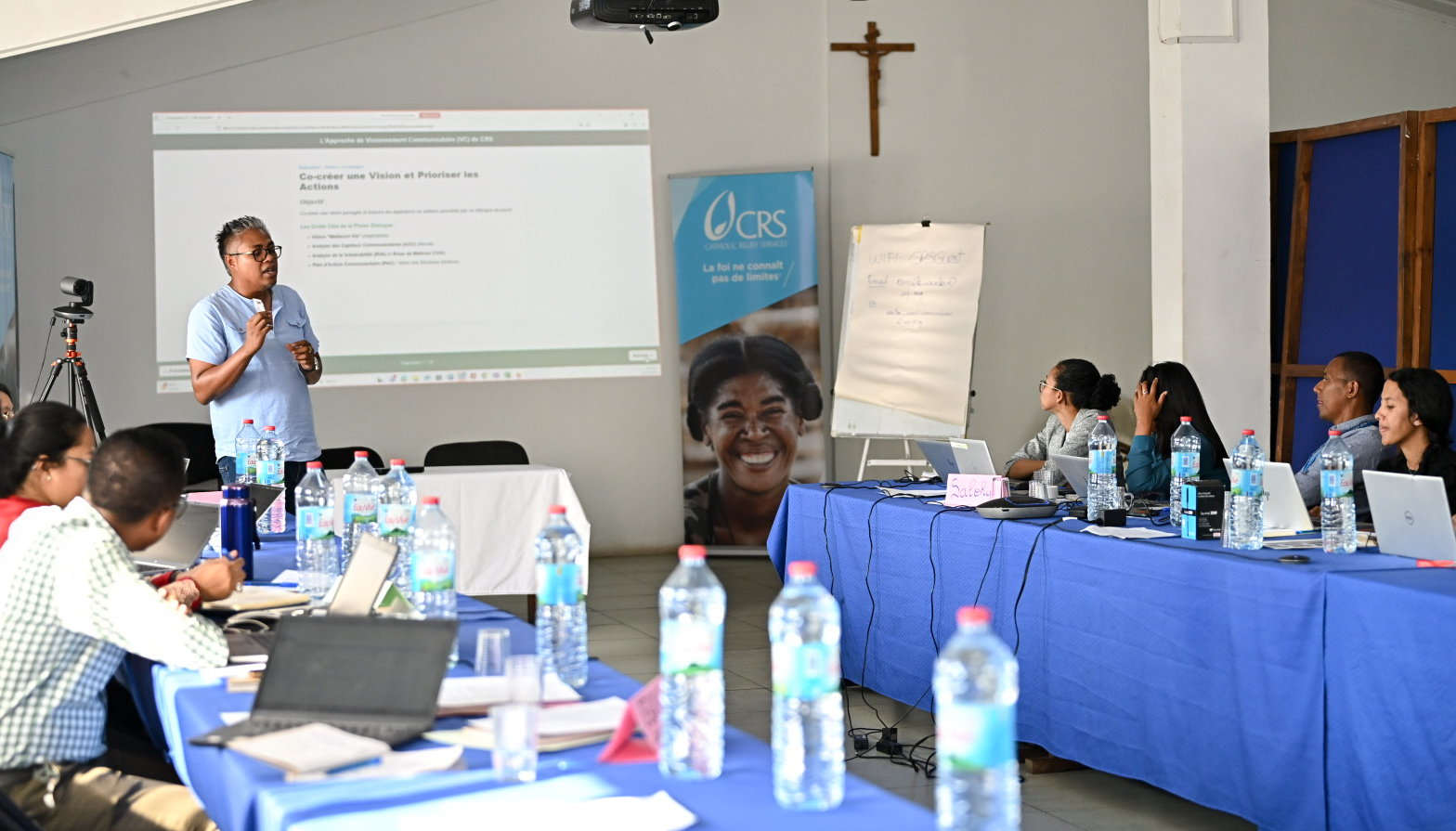
Photo credit: Sedera Ramanitra, Catholic Relief Services
Antananarivo, Madagascar, 30 October 2025 — Catholic Relief Services (CRS), with support from the Global Center on Adaptation (GCA) and government partners, convened an initiation workshop in Antananarivo on October 29–30, 2025, to launch the People’s Adaptation Planning pilot under the World Bank–financed MIONJO Project. The initiative brings together key national and local institutions to strengthen community-led planning and empower citizens to take the lead in building climate resilience in southern Madagascar.
Southern Madagascar faces recurrent drought, chronic food insecurity, limited infrastructure, and increasing exposure to climate hazards such as extreme heat, strong winds, cyclones, and heavy rainfall. The MIONJO Project aims to improve access to basic infrastructure, strengthen livelihood opportunities, and reinforce local governance in this region, with a particular focus on women and youth.
Launched in 2020, the project initially supported rapid response to drought-related emergencies through its contingency financing window. The current second phase marks a shift from short-term crisis response toward long-term investments in decentralization, climate resilience, and local development. It is focused on participatory and climate-informed planning at the commune level, including through financing mechanisms such as the Fonds de Développement Local (FDL, or Local Development Fund). These efforts are intended to strengthen institutional capacity and integrate climate resilience into decentralized governance systems to lay the groundwork for more sustainable, community-driven development across the region.
Participants at the initiation workshop for the the inputs supported by the GCA included representatives from the Ministry of Decentralization, the Ministry of Environment and Sustainable Development—including the National Bureau for Climate Change (BNCCC)—and the MIONJO Project Management Unit, among others. Together, they explored how the People’s Adaptation Planning approach can enhance existing local development processes by ensuring that adaptation priorities are defined and driven by the people most affected by climate impacts.
“We often go to communities thinking we know better, bringing ready-made solutions for them to adapt to climate change," noted Rado Ravonjiarivelo, Chief of Party at CRS Madagascar. "But those solutions don’t always match their reality. That’s why the People’s Adaptation Plan matters, it reminds us to listen first. Communities understand their environment better than anyone else, and real adaptation starts by hearing their voices and building from those lived realities upward.”
The workshop sparked rich discussions, with institutions sharing their ongoing efforts to integrate climate adaptation into local governance and identifying opportunities to align these with the People’s Adaptation Planning process.
Participants recognized the potential of the People’s Adaptation Planning approach to bridge existing initiatives and foster a more coordinated, community-driven approach across Madagascar’s territories. “This initiative, at scale, represents a promising opportunity to capture the unique local contexts across all regions, enabling FDL to make informed investments in people and their plans,” noted Mirana Andrianaivo, Project Coordination Manager at FDL.
Partners jointly developed a Project Charter outlining inclusive and participatory decision-making principles for the pilot’s implementation. The Charter ensures that each institution’s expertise contributes to the success of the pilot and to the broader dissemination of lessons learned. A detailed implementation plan was also finalized, laying the foundation for the next phase of collaboration under the MIONJO program and reinforcing Madagascar’s commitment to locally led climate adaptation.